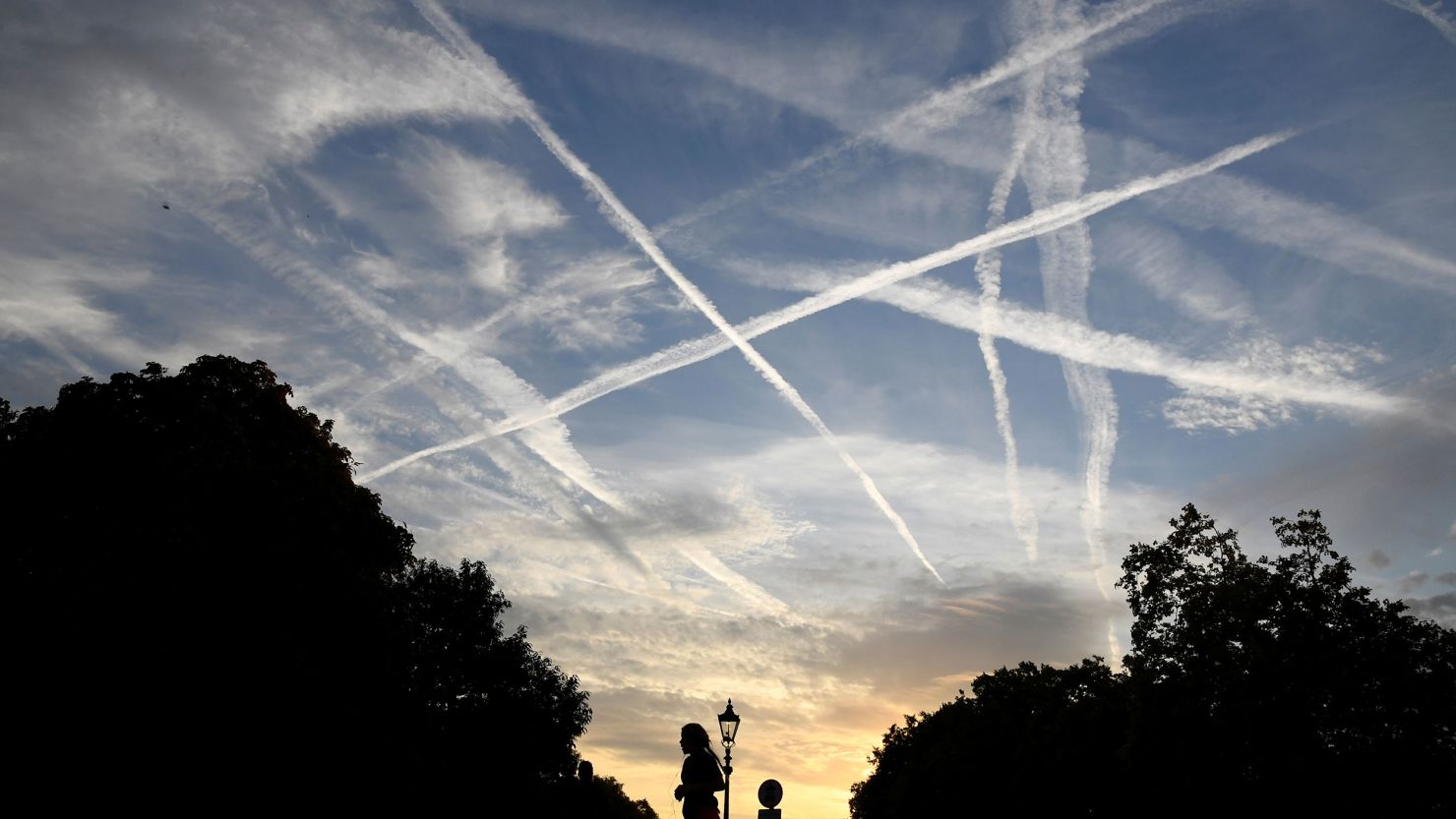
Contrails (/ˈkɒntreɪlz/; short for „condensation trails“) or vapour trailsare line-shaped clouds produced by aircraft engine exhaust or changes in air pressure, typically at aircraft cruising altitudes several kilometres/miles above the Earth’s surface. They are composed primarily of water, in the form of ice crystals. The combination of water vaporin aircraft engine exhaust and the low ambient temperatures at high altitudes cause the trails‘ formation.
Impurities in the engine exhaust from the fuel, including soot and sulfurcompounds (0.05% by weight in jet fuel) provide some of the particles that serve as cloud condensation nuclei for water dropletgrowth in the exhaust. If water droplets form, they can freeze to form ice particles that compose a contrail.[1] Their formation can also be triggered by changes in air pressure in wingtip vortices, or in the air over the entire wing surface.[2] Contrails, and other clouds caused directly by human activity, are called homogenitus.[3]
The vapor trails produced by rockets are referred to as „missile contrails“[4] or „rocket contrails.“ The water vapor and aerosol produced by rockets promote the „formation of ice clouds in ice supersaturated layers of the atmosphere.“[5][6] Missile contrail clouds mainly comprise „metal oxide particles, high-temperature water vapor condensation particles, and other byproducts of engine combustion.“[5]
Depending on the temperature and humidity at the altitude where the contrails form, they may be visible for only a few seconds or minutes, or may persist for hours and spread to be several kilometres/miles wide, eventually resembling natural cirrus or altocumulus clouds.[1] Persistent contrails are of particular interest to scientists because they increase the cloudiness of the atmosphere.[1] The resulting cloud forms are formally described as homomutatus,[7] and may resemble cirrus, cirrocumulus, or cirrostratus, and are sometimes called cirrus aviaticus.[8] Some persistent spreading contrails contribute to climate change.[9]
Engine exhaust is predominantly made up of water and carbon dioxide, the combustion products of hydrocarbon fuels. Many other chemical byproducts of incomplete hydrocarbon fuel combustion, including volatile organic compounds, inorganic gases, polycyclic aromatic hydrocarbons, oxygenatedorganics, alcohols, ozone and particles of soot have been observed at lower concentrations. The exact quality is a function of engine type and basic combustion engine function.[10] At high altitudes as this water vapor emerges into a cold environment, the localized increase in water vapor can raise the relative humidity of the air past saturation point. The vapor then condenses into tiny water droplets which freeze if the temperature is low enough. These millions of tiny water droplets and/or ice crystals form the contrails. The time taken for the vapor to cool enough to condense accounts for the contrail forming some distance behind the aircraft. At high altitudes, supercooled water vapor requires a trigger to encourage deposition or condensation. The exhaust particles in the aircraft’s exhaust act as this trigger, causing the trapped vapor to condense rapidly. Exhaust contrails usually form at high altitudes; usually above 8,000 m (26,000 ft), where the air temperature is below −36.5 °C (−34 °F). They can also form closer to the ground when the air is cold and moist.[11]
Condensation from decreases in pressure
A vintage P-40 Warhawk with propeller tip vortex condensation
The tips of rotating surfaces (such as propellers and rotors) sometimes produce visible contrails.[12]
In firearms, a vapor trail is sometimes observed when firing under rare conditions, due to condensation induced by changes in air pressure around the bullet.[13][14] A vapor trail from a bullet is observable from any direction.[13] Vapor trail should not be confused with bullet trace, a refractive effect due to changes in air pressure as the bullet travels, which is a much more common phenomenon (and is usually only observable directly from behind the shooter).[13][15]
Contrails‘ contribution to climate change might be similar to CO 2 emissions from aviation, but this depends on the time horizon chosen. In general, aircraft contrails trap outgoing longwave radiation emitted by the Earth and atmosphere more than they reflect incoming solar radiation, resulting in a net increase in radiative forcing of around 0.03–0.06 watts per square meter (W/m²).[16] Contrail effects differ a lot depending on when they are formed, as they decrease the daytime temperature and increase the nighttime temperature, reducing their difference.[17] Most of the contrail heating is over Europe, North America, and the North Atlantic, whereas flights in other regions such as East Asia are often through warmer air so less likely to form contrails.[18]
The effect of COVID-19 reductions in flight traffic decreased contrails. The unique timing of such reductions, which were maximum in Northern Hemisphere summer, when the largest contrail cooling occurs, means that warming reductions due to fewer contrails in the spring and fall were offset by cooling reductions due to fewer contrails in summer, giving no significant annual averaged effective radiative forcing (ERF) from contrail changes in 2020. Despite no net significant global ERF, there are some land regions that cooled significantly and up to −0.2 K from what would have been expected with baseline aviation contrails. These reductions occurred in the same regions as large contrail temperature changes in the subtropical Northern Hemisphere.[19]
Despite the extra fuel required it is thought that rerouting (probably a slight height change) a small proportion of flights would significantly reduce overall heating, and cleaner fuels (such as sustainable aviation fuel) and newer engines might also help.[18] Further research may be needed,[20][21] such as how to estimate the systematic effects of rerouting[22] and how much air traffic controllers‘ workload would increase.[23] Projects include ContrailNet from Eurocontrol,[24] Reviate,[25] and the Ciconia project,[26] as well as Google’s ‚project contrails‘.[27] Others such as Satavia, which is part of GE, say that atmospheric regions at risk of contrails are known well enough already, and that it could be done now very cheaply, simply by modifying flight plans.[28]
Since 2025 the EU has required the warming from contrails to be monitored.[22]European efforts to 2027 are coordinated by the Aviation Non-CO 2 Expert Network,[29]but in 2025 the National Academies of Sciences, Engineering, and Medicine criticised research in the USA as „fragmented“.[30] As of 2025 most contrails cannot be seen by geostationary satellites,[31] but they can be complemented with sun synchronous satellites and ground observations.[32] Satellite and ground based lidar can also help detect contrails, and visible ground observation can help show which flight created a contrail.[33]
Head-on contrails
A contrail from an airplane flying towards the observer can appear to be generated by an object moving vertically.[34][35] On 8 November 2010 in the US state of California, a contrail of this type gained media attention as a „mystery missile“ that could not be explained by U.S. military and aviation authorities,[36] and its explanation as a contrail[34][35][37] took more than 24 hours to become accepted by U.S. media and military institutions.[38]
Distrails
A distrail is the opposite of a contrail
Where an aircraft passes through a cloud, it can disperse the cloud in its path. This is known as a distrail (short for „dissipation trail“). The plane’s warm engine exhaust and enhanced vertical mixing in the aircraft’s wake can cause existing cloud droplets to evaporate. If the cloud is sufficiently thin, such processes can yield a cloud-free corridor in an otherwise solid cloud layer.[39] An early satellite observation of distrails that most likely were elongated, aircraft-induced fallstreak holes appeared in Corfidi and Brandli (1986).[40]
Clouds form when invisible water vapor condenses into microscopic water droplets or into microscopic ice crystals. This may happen when air with a high proportion of gaseous water cools. A distrail forms when the heat of engine exhaust evaporates the liquid water droplets in a cloud, turning them back into invisible, gaseous water vapor. Distrails also may arise as a result of enhanced mixing (entrainment) of drier air immediately above or below a thin cloud layer following passage of an aircraft through the cloud, as shown in the second image below:[citation needed]
Ritchie, Glenn; Still, Kenneth; Rossi Iii, John; Bekkedal, Marni; Bobb, Andrew; Arfsten, Darryl (2003). „Biological and health effects of exposure to kerosene-based jet fuels and performance additives“. Journal of Toxicology and Environmental Health, Part B. 6 (4): 357–451. Bibcode:2003JTEHB…6..357R. doi:10.1080/10937400306473. PMID12775519. S2CID30595016.
Corfidi, Stephen; Brandli, Hank (May 1986). „GOES views aircraft distrails“(PDF). National Weather Digest. 11: 37–39. Archived(PDF) from the original on 21 April 2017. Retrieved 13 October 2021.
____________________ genausogut können Sie natürlich auch unsere Brüder fragen, die das volldurch dauergenießen:
Waldsterben
großflächige Schädigungen des Waldbestandes
Und wir HERZILEINS AUS ALLEN GLOABLISTENKISTEN HABEN KEINE AHNUNG WARUM!!! DIE ARMEN ARMEN BAUMIS!!!
Waldsterben
Als Waldsterben werden Schädigungen des Waldes bezeichnet, die seit etwa 1980 großflächig auftreten. Das Verbreitungsgebiet umfasst Mittel-, Nord- und Osteuropa. Charakteristisch ist, dass sich die Schadensbilder im Wald unabhängig von Klima, Standort und waldbaulichen Praktiken zeigen. Die Symptomatik differiert zwisc… Wikipedia
wie schreibt die verehrte Frau Scotti-Planyavsky doch so wahr? DEE HIENICHN kriegen sich NICHT UND ICHT AUF EINEN NENNER! Und so meinen SIE, die WIRKUNGSMÜHLE AM LAUFEN ZU HABEN, und das mit Hirntasserln, wo kein Schnapsgerucht nicht einnmal reinpaßt. ZUSAMMEN-HÄNGE.. sollen WIR nicht kapieren, die die so deppert sind, zusammenzustoppeln: ZU NIEMANDES, AUCH IHRER NICHT, GEWINN. DENN FIA DEES SANN’S Z_beld! Wie wen iich einen Sportwagenmotor konstruiere soll… WIR KÖNNEN VON GLÜCK REDEN, wenn’s ein tauglicher Trittroller wird! UND DA BIN ICH EHRLICH SUPERGUT. Für was ich eben kann.. JA! ICH STEHE DAZU, diese nicht. Warum ich so weise bin? Naja, ich bin nur nicht so unfaßbar superdeppert…..
Superdünne Polymerfasern im Chemtrailsfallout – auch in Deutschland! Wozu sind Mikro-Polymer-Fasern in Chemtrails? Hand nach rechts Erzeugen die Polymer-Fasern …
WIE HIENICH DEPPERT MUSZ ICH, also wie KLASI SCHWABBEL MUSS ICH dampfig aufgedunsen bitte sein, daß mir nicht klar ist, daß Echtmenschen ja ALLES GENAUSOGUT NACHFORSCHEN und WEITAUS BESSER ALS ALLE MEINE MITHIENICHEN DENKWERKGEHEN, also lernen, folgern, nachdenken, weiterarbeiten, ausprobieren, herumversuchen und entdecken KÖNNEN!!
Hmmmm?
MIA SANN NEED UNTA AICH DEPPAD, und vor allem WIR SIND ERDE! Richtig und von ihr tiefengwebegetragen und „GELIEBT“!!! Und wir lieben SIE, was uns hier restlos anders raumeinbinden IMMER WIRD und euch AN ALLEM FUMMEL KARKASSEN NIE! Ich verstehe, daß ihr icht kapieren wollt, daß ihr RAUMWAHR – für uns auch, ja.. aber das zählt erst zweitrangig… ____ das Hinterletzte seid, und zwar als Verlorenes… Gesch…jaja… n.es.
IHR SEID NICHT FÄHIG, euren ABSCHIED ZU DENKEN!
Ihr seid nicht fähig, euer Gehen zu denken – das IN EINEM KOSMOS DES WANDELNS FÜR EGAL WELCHES GEBILDE DIE MITWERDEREGEL ISt..
ihr seid.. unbegREIFLICH NICHT REIGUNGSFÄHIG in keiner Particelluccia! NICHTS AN EUCH hat IRGENDEINE MITVERNUNFT IN SICH auch nur als Spurenelement.
Es ist, ihr seid.. ein namenlos langweiliges Sichallemalsgöttervorhupferpossenspiel. Unfaßlich derber Art, jaaa…..
Posse, die
GrammatikSubstantiv (Femininum) · Genitiv Singular: Posse · Nominativ Plural: Possen
derb-komisches Bühnenstück, dessen Komik meist durch Übertreibung erreicht wird
Beispiele:
eine Posse spielen, ansehen
eine Posse von Nestroy
»Bühne frei« für das Stück »Zuagricht … Hergricht … Higricht« hieß es am Wochenende für die Posse von Autor Georg Maier – ein Stück Dichtung und Wahrheit über den Räuber Mathias Kneißl, wobei die Dichtung durchaus wahr sein könnte.[Mittelbayerische, 06.07.2015]
»Gogols ›Heirat‹ ist keine derbe Posse, sondern ein wahres, künstlerisch reproduziertes Sittengemälde der Mittelschichten der Petersburger Gesellschaft«, schrieb der russische revolutionär‑demokratische Philosoph und Publizist Belinski.[Berliner Zeitung, 21.12.1978]
Übrigens war das Haus Heit nicht das einzige, in dem ich meine schwachen schauspielerischen Talente leuchten ließ, erst im Jahre vorher war ich bei Horns zweimal in der ordinären Posse »Zwei Taube« aufgetreten, einmal als der junge Liebhaber, der sich taub stellt, und das zweite Mal als der alte, der von seiner Taubheit durch eine Wunderkur geheilt wird.[Schnitzler, Arthur: Jugend in Wien. In: Simons, Oliver (Hg.): Deutsche Autobiographien 1690–1930. Berlin: Directmedia 2004 [1918]]
●
übertragenunerfreuliches, oft zu Spott Anlass gebendes Ereignis oder Geschehen (meist in der Politik)
Die Posse um die Hunde von US‑Schauspieler Johnny Depp und seiner Frau Amber Heard geht in die nächste juristische Runde. Im kommenden Jahr soll der Fall in Australien vor Gericht verhandelt werden.[Der Spiegel, 07.12.2015 (online)]
Die Bayern [Verein FC Bayern München] hatten rund um die elfte Meisterschaft in Serie bekannt gegeben, dass CEO Oliver Kahn und Sportvorstand Hasan Salihamidzic gefeuert werden. Während »Brazzo« Salihamidzic diese Nachricht[…] akzeptierte, kam es mit Torwartlegende Kahn zu keiner einvernehmlichen Lösung, es folgte eine unwürdige Posse.[Hoeneß stiftet Unruhe beim FC Bayern, 31.05.2023, aufgerufen 03.06.2023]
Keine Bratwurst mehr auf Volksfesten? Fleischfans fassungslos [Überschrift] Der Wurst‑Zoff von Würzburg ist mehr als eine regionale Posse. Er steht symbolhaft für das gespaltene Verhältnis der Deutschen zum Fleisch – und für einen ideologisch aufgeladenen Streit um die Frage, ob der Verzehr von Tieren noch zeitgemäß[…] ist.[Streit in Würzburg befeuert deutsche Fleisch-Debatte, 22.05.2023, aufgerufen 03.06.2023]
Kurz vor Weihnachten bog sich der Amtsschimmel vor Gelächter. Anlass für die Posse war die Treppe zwischen Holzgartenstraße und Richard‑Wagner‑Straße. Diese Passage, die als Abkürzung vom Marienstein aus gern benutzt wurde, war plötzlich nicht mehr begehbar, was allenthalben auf Unverständnis und Kritik stieß. Manfred C[…], der Chef des städtischen Tiefbauamtes, rechtfertigte die Sperrung damit, dass die fußläufige Anbindung auf Grund von Bürgerbeschwerden abgeriegelt worden sei.[Saarbrücker Zeitung, 18.12.2004]
Er erklärte u. a., jene Versammlung bedeute nichts als ein Lustspiel, eine Komödie und Posse, bei der leider ein Kollege den Komiker gespielt habe.[Berliner Tageblatt (Morgen-Ausgabe), 18.02.1902]
Possen · Possenspiel · Posse · Possenreißer · possierlich
Possenm., meist Plur., ‘derber Streich, Unfug, Schabernack’, mhd. possen (Plur.). Auszugehen ist von (allerdings später bezeugtem) frühnhd. posse, bosse ‘Zierat, Beiwerk’ _____kommt daraus noch die Paramentiererin?? Help! 🍒_ (an Kunstdenkmälern, Gesimsen), besonders ‘groteske Figuren’ (an Brunnen). Dies ist entlehnt aus afrz. boce, frz. bosse ‘Buckel, Höcker, Beule, Relief, erhabene Arbeit, Gipsabguß’. Zugrunde liegt vielleicht anfrk. *bottia ‘Auswuchs, Sproß, Beule’, das Substantivbildung zu einem dem ahd. bōʒen ‘stoßen, schlagen’ (s. Amboß) entsprechenden anfrk. Verb (mit der Bedeutungsvariante ‘ausschlagen, sprießen’?) wäre; vgl. Gamillscheg ²128. Schon früh erfolgt die Übertragung von ‘komische Figur, Scherzfigur’ auf ‘Scherz, lustiger Streich’, wozu die Zusammensetzung
(ein) Schwank aus jemandes Leben · (eine) Geschichte, die das Leben schrieb · Anekdote · Posse · Schwank · lustige Geschichte ● Döneken rheinisch · Story ugs.
„Posse“, bereitgestellt durch das Digitale Wörterbuch der deutschen Sprache, <https://www.dwds.de/wb/Posse>, abgerufen am 16.02.2026.Weitere Informationen …
Nicht als Folterblutsäufer unserer Menschenkinder,
nicht als Menschenfleischfickeinfotter,
nicht als Erdevergifterhieniche, die meinen, SO SEIEN SIE DIE HERREN… IHR REGIERT NICHT EINMAL EINEN AMEISENHAUFEN! So, daß der gedeiht, das meine ich!!!!
Ich KANN diese Egolurchwabblerei durch die herrliche Erde NICHT MEHR HABEN. Ende, aus, RAUS!!
RENATURIERT DIE IN IHREM HERKUNFTSKOSMOSQUADRANTEN als KrabbeltTIikakerlakenakenaken die dortigen Rinnsteine entlang!!